
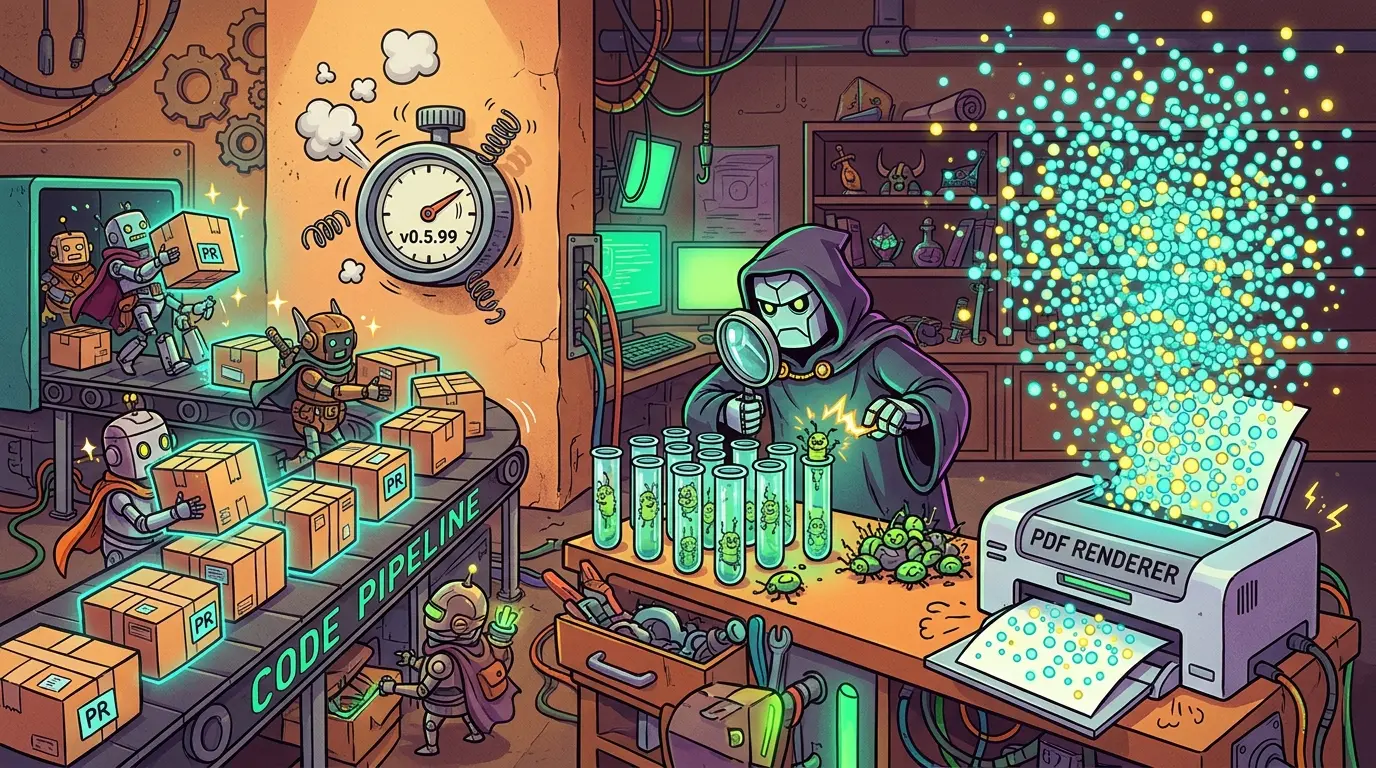
When I originally set up the version math for my personal Android nutrition app, I used the classic formula almost every mobile developer copies into their build scripts: multiply the major version by ten thousand, the minor version by one hundred, and tack the patch number onto the end. For a human developer, assuming you will never ship one hundred patch releases before bumping a minor version is completely reasonable. Then I turned a squad of local AI minions loose on a seventeen-ticket sprint, and by Friday night they nearly broke my version odometer.
Because my local agents pick up tickets, review each other's diffs, and merge a fresh patch release for every tiny cleanup, they burn through version numbers at a hilarious pace. Nobody warns you that autonomous coding bots will treat your two-digit patch counter like a high-score table. Watching a build script threaten to halt the pipeline because patch 99 was right around the corner was a funny problem to have; I ended up having the agents widen the version scheme and wire version fallback checks directly into local CI so they could keep shipping without bricking the compiler.
The cool part of that sprint, though, was watching my dual-model review setup pay for itself. While Frodo and Gollum were cranking out code and unit tests, my review bots, Mandos and Aragorn, were auditing every pull request before it could land. On one ticket, the coding bots wrapped my on-device AI inference calls in broad try-catch blocks so errors would fail gracefully. It looked clean on the surface; however, Mandos spotted that catching every exception also swallowed Kotlin's coroutine cancellation signal. In plain English, if I backed out of a screen while a model was thinking, the background task would never actually stop (hello, zombie CPU drain). Instead of just fixing that one file, the agents wired a custom static analysis rule into the build that automatically fails any catch block that forgets to rethrow cancellation or check whether the job is still active.
They pulled off the same trick on the unit tests. Left to their own devices, coding models love writing cheerful tests that light up green while asserting almost nothing. Rather than trusting the green checkmarks, the review agents deliberately mutated my list-selection logic to see if the new tests would actually fail. Two mutants survived right past the test suite, which forced another pass to tighten the assertions until the bugs were actually caught.
I ran into one more surface-level AI quirk the next morning while prepping a one-page health summary chart for my annual doctor's visit. I had an assistant plot a full year of my daily wearable data (365 weight points, 365 resting heart rate readings, and 152 blood pressure logs) and export it to a PDF. Headless Chrome immediately crashed. It turned out the AI had styled every tiny SVG dot with semi-transparent opacity and rgba borders, quietly spawning 1,062 nested transparency layers on a single page. Swapping those styles to flat hex colors fixed the crash in thirty seconds, and I walked out with a crisp one-page chart. Between the widened version counter, the mutation checks, and the new static analysis trap, the best part of this setup is that the bots never make the same mistake twice; every time they trip over an edge case, the pipeline gets a permanent upgrade.
Later,
SteveO